
Implant Dentures in Sterling Heights, MI
If you’ve been wearing a denture for any length of time, you already know the issues. The lower one moves around. The upper one covers your palate. You think twice before laughing at dinner. These are the natural limitations of a conventional denture, and they’re what implant dentures were meant to solve.
At St. Apollonia Dental, we offer three implant-based alternatives to traditional dentures: denture stabilization, semi-removable roundhouse bridges, and cemented roundhouse bridges. They vary in cost and removability, but truly, they’re all good options. The right one for you will depend on your situation, your expectations, and your budget.
The Problems With Conventional Dentures
A conventional denture replaces your missing teeth with plastic. It sits on your gums and relies on suction, adhesive, or sheer willpower to stay put. For the upper jaw, it usually manages okay. The lower jaw is notoriously difficult to master. In his 43 years of practice, Dr. Pearson has watched enough patients struggle with lower dentures that he no longer places them without implant support.
Even when conventional dentures are made well, they’ll lose their fit over time. The reason for this is bone loss, which worsens the longer you’ve had your dentures. When your natural teeth were present, the roots were constantly stimulating the jawbone, telling it to stay dense and intact. Once the teeth are gone, that stimulation stops, and the bone gradually deteriorates. The longer you wear a conventional denture, the more bone you tend to lose and the less stable the denture becomes.
This creates a challenge when patients come to us wanting dental implants. If the bone has diminished significantly, there may not be enough of it to work with in the usual places. That’s a big reason we so frequently place mini dental implants for dentures. Because they’re smaller in diameter, we can often place them in the bone you do have available.
The Benefits of Implant Dentures
Once implants are in, the problems conventional dentures create tend to disappear. Implants improve things like:
- Stability: The denture is anchored to the jaw. It doesn’t shift, rock, or float around while you chew.
- Confidence: You can eat at a restaurant, sneeze, and laugh without thinking twice. This peace of mind can be life-changing for denture wearers.
- Taste and nutrition: Implant-supported restorations either reduce or eliminate the plastic plate covering the roof of your mouth, which drastically improves your ability to taste food. Chewing efficiency improves as well, allowing you to eat nutritious meals that may be challenging with conventional dentures.
Once we anchor your restoration to the jaw, you’re no longer fighting physics. And depending on how permanent you want your solution to be, there are three directions we can go from here.
Implant Dentures: What Are My Options?
At St. Apollonia Dental, we offer three full-arch implant systems:
Denture Stabilization
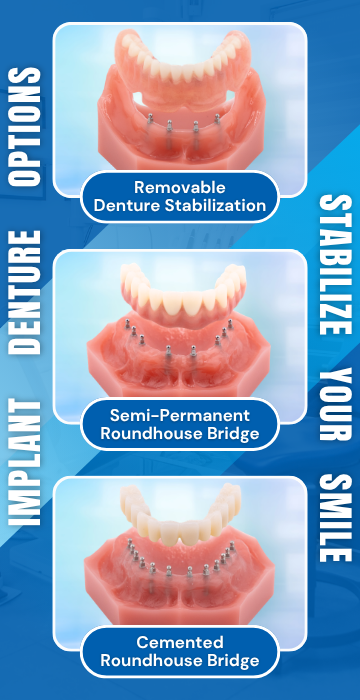 This is the most budget-friendly implant option for replacing a full arch of missing teeth. A full set of implant-stabilized dentures costs about $7,000-$8,000. For many patients, it’s a practical starting point.
In a single visit, Dr. Pearson can place about 4 mini implants in the lower jaw or 6 in the upper, and add clips to the underside of your existing denture. The denture snaps right onto the implants, and you’ll leave with a denture that actually stays put.
If you don’t have a denture yet, we can build one for you. Either way, the materials are the same as a conventional denture, though a bit less bulky. The main difference is that it no longer moves.
Semi-Removable Roundhouse Bridge
The semi-removable roundhouse bridge is the most common full-arch restoration Dr. Pearson places, and it’s easy to see why: it hits a strong middle ground between cost and permanence.
Gone is the plastic base of a conventional denture. Instead, the restoration is a series of connected teeth that sit right on top of 6 to 10 mini implants. The restoration is cushioned by small rubber O-rings on the underside that absorb chewing forces and reduce the number of implants needed.
We call this option “semi-removable” because you can’t remove it yourself. Dr. Pearson can, and does, at your regular cleanings, to keep everything properly maintained. Built from scratch over a series of appointments and running about $16,000, this is a significant step up from denture stabilization in both feel and function.
Cemented Roundhouse Bridge
We also offer a roundhouse bridge that never comes out. It’s the most permanent option we offer and, at about $20,000, it sits at the top of the price spectrum. It looks like the semi-removable version, but we cement the restoration onto 10 to 12 mini implants with a hard dental cement. It doesn’t come out.
With a roundhouse bridge like this, there’s no soaking it overnight, no risk of dropping it, no taking it out at all. For patients who want the closest thing possible to having their own teeth back, this is it.
The Implant Denture Process
If you’re interested in one of the implant denture options above, you’re likely wondering what the next step is. Getting implant dentures starts with a free consultation. Dr. Pearson will examine your mouth, take a CBCT scan of your jaw to assess bone density and nerve locations, and review your options with you in detail. The planning is where the success of your treatment is largely determined. Knowing what we’re working with before a single implant is placed makes everything that follows more predictable.
From there, regardless of which implant denture option you choose, the next step is implant placement. Mini implant placement is far less involved than most patients expect. There are no nerve endings in the jawbone, so the actual tissue disruption amounts to small pilot holes. Most patients take little more than an aspirin afterward.
After placement, the process shifts depending on your restoration. Denture stabilization wraps up the same day: Dr. Pearson adds clips to your existing denture right then, and you leave with a denture that stays put. A semi-removable or cemented roundhouse bridge requires a few more appointments to make sure everything fits and looks exactly right.
For longer appointments, particularly roundhouse cases involving extractions, Dr. Pearson offers oral sedation. These are safe medications in the benzodiazepine family that help you feel more relaxed during your procedure. Many patients find they remember very little of the procedure at all. Even for patients who aren’t particularly anxious, sedation can make a long appointment considerably more comfortable.
Considering Implant Dentures? Book a Free Consultation!
A denture that moves, slips, or comes out at the wrong moment isn’t something you just have to live with. At St. Apollonia Dental, we offer options at a range of price points. While each restoration works a little differently, the result is the same: teeth that stay where they belong.
If you want a more stable denture, a free consultation is the place to start. Dr. Pearson will review your bone structure, explain your options honestly, and help you figure out which direction makes the most sense. From there, it’s just a matter of getting it done. Ready to take the first step? Book your free consultation today.
Frequently Asked Questions
Dr. Pearson’s biggest issue with All-on-4 comes down to simple math. You have four implants holding everything together. If one implant fails, the whole case must be redone. Starting over from scratch at that point is expensive and disruptive.
The other concern is that conventional dental implants, which All-on-4 uses, take up more space. In some cases, dentists actually have to shave down the jawbone to create room. At St. Apollonia Dental, we go out of our way to preserve bone. Taking it away isn’t something Dr. Pearson is willing to do.
For patients interested in All-on-4, Dr. Pearson recommends a semi-removable or cemented roundhouse bridge supported by mini implants. More implants mean more stability, and if one ever fails, the fix is much simpler.
The honest answer is that it largely depends on you. The only long-term failures we’ve seen at our office were due to poor oral hygiene. When patients take care of their smile and come in for regular checkups, there’s no reason their restorations couldn’t last for 20 years or more. St. Apollonia Dental backs that up with a 5-year warranty on all implant work, provided you use your Waterpik consistently and come in for routine visits.
Just like anything else: take care of it, and it’ll take care of you.
Few people buy a car with cash from their own pocket. They finance it, pay it off over time, and enjoy it from day one. Implants work the same way. Our practice offers payment plans that can stretch as long as 12 years, with interest-free options available for up to 2 years.
Our team will help you maximize your insurance coverage, apply for financing, and work out a monthly payment you’re actually comfortable with. When you look at what a full-arch dental implant system can do for your confidence, nutrition, and quality of life, the cost starts to look less like an expense and more like a decision that pays you back every day.
Related Videos
- What Denture Options Are Available?
- What To Do If Your Dentures Are Loose
- What Is an Implant Denture?
- How Many Implants Are Needed To Stabilize a Denture?
- Can My Current Denture Be Converted to an Implant Denture?
- What Are the Benefits of Implant Dentures?
- Will Implant Dentures Affect My Ability To Eat and Speak?
- Who Is a Candidate for Implant Dentures?
- Does Getting an Implant Denture Hurt?
- What Are All-on-4 Dental Implants?
- What Is a Snap-In Denture?
- What Is a Semi-Removable Denture?
- What Is a Roundhouse Bridge?
- The Implant Denture Process Explained Step by Step
- How Long Does the Implant Denture Process Take?
- How Do I Care for My Implant Denture?
- How Much Do Implant Dentures Cost?
- Does Insurance Cover Implant Dentures?
- Do You Offer Payment Plans for Implant Dentures?