
Dental Implants in Sterling Heights, MI
Losing a tooth is stressful enough without having to sort through conflicting information about dental implants. Many patients assume there’s one “best” type of implant, but the right choice depends on factors specific to your mouth, such as which tooth needs replacing, the density and width of your jawbone, and the kind of restoration being supported.
At St. Apollonia Dental, Dr. Pearson places both conventional dental implants and mini dental implants. He views them as different tools in the same toolbox. In some cases, a conventional implant provides the strongest long-term solution. In others, a minimally invasive mini dental implant can restore function with less disruption to your life. Rather than forcing every patient into the same treatment approach, Dr. Pearson selects the option that fits your situation best.
The Benefits of Dental Implants
Today, dental implants are considered the gold standard for replacing missing teeth. Regardless of which type of implant is right for you, implants offer something that bridges and traditional dentures simply can’t: they replace both the visual tooth and the lost root.
Dr. Pearson places these titanium implants directly into the jawbone, where they function as artificial tooth roots. As a result:
- They stop bone loss. Without tooth roots, the jawbone no longer receives the stimulation it normally gets during chewing, so it begins to shrink. A dental implant takes the root’s place and stops the jaw from deteriorating.
- They don’t compromise neighboring teeth. Placing a traditional fixed bridge requires reshaping the healthy teeth on either side of the gap, while a partial denture relies on neighboring teeth for support. A dental implant stands on its own, replacing the missing tooth without compromising surrounding teeth.
- They stay put. Traditional dentures (especially on the lower jaw) shift when you eat and speak. Implant-supported restorations are securely anchored in the jaw.
- They restore chewing efficiency. Patients with implant-supported restorations chew more effectively than those with dentures, which translates to better nutrition.
- They’re longer lasting. With proper home care and routine checkups, a well-maintained implant can last 20 years or longer.
Types of Dental Implants
There are two main types of dental implants: conventional implants and mini dental implants. Both are titanium posts that bond with the jawbone and support replacement teeth. The differences in size and design determine when each one is used.
Conventional Dental Implants
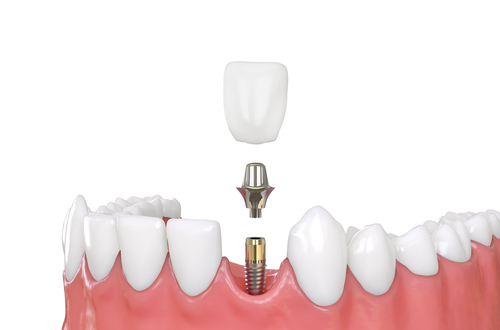 Conventional implants are 3 mm or wider in diameter and are built from three separate components: the implant body, which is placed in the jawbone; the abutment, which connects to the implant body and sits above the gum line; and a screw that holds the two pieces together.
Because of their larger diameter, conventional implants require more bone width to place and a longer healing period of 4-6 months beneath the gum before Dr. Pearson can attach replacement teeth.
While their timeline and invasiveness can be drawbacks, their larger size and protected healing environment make conventional implants the right choice in two specific situations:
- Replacing molars: Back teeth absorb significantly more chewing force than other teeth. Over time, small-diameter implants in that position can break under that stress. Dr. Pearson uses conventional implants for molars about 90% of the time.
- Placing implants in soft or low-density bone: A conventional implant’s body heals entirely beneath the gum in a fully protected environment. With the gum closed over the top and nothing protruding above it, there’s nothing to disturb the implant during the 4 to 6 months it takes to integrate with the bone. That undisturbed healing period is what makes conventional implants viable in softer bone, where a smaller implant may fail.
Mini Dental Implants
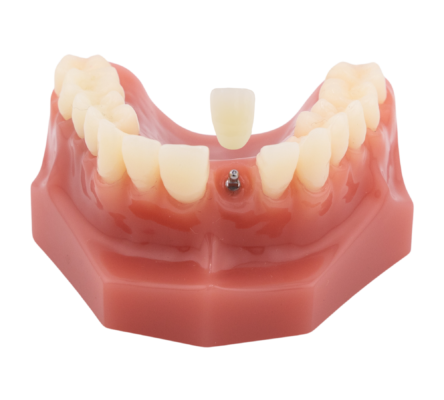 Mini dental implants are one-piece implants that measure less than 3 mm in diameter. Rather than three separate components, a mini implant is a single continuous piece of titanium. That simpler design allows Dr. Pearson to use a less invasive technique to place the implants. And with less invasive treatment, patients experience easier healing and a shorter path to their final results.
Because of their narrower profile, mini implants work well in areas with limited bone width, making use of the bone you already have without the need for a bone graft.
Dr. Pearson uses mini implants for single teeth, bridges, implant-stabilized dentures, and roundhouse bridges. For most areas of the mouth besides molars, they’re his first choice thanks to their simpler, less invasive placement, high success rate, and lower cost.
The Dental Implant Procedure
The differences in size and design between conventional and mini implants affect many aspects of the treatment process:
Conventional Implant Procedure
Every case starts with a free consultation, where Dr. Pearson examines your teeth, reviews your medical history, and takes a cone beam CT scan: a 3D image showing the density, structure, and dimensions of your jawbone.
At the placement appointment, Dr. Pearson drills a series of progressively wider holes into the jawbone until the opening matches the full length and diameter of the implant body. He then screws in the implant and closes the gum over the top, leaving the implant to heal entirely beneath the gum line.
Over the next 4 to 6 months, the bone grows around and integrates with the implant in a process called osseointegration. Once that’s complete, Dr. Pearson attaches the abutment, takes an impression, and sends it to a dental lab for your custom restoration.
All said and done, treatment can take several months, but the result is a long-lasting replacement that functions like a natural tooth.
Mini Implant Procedure
The mini implant process starts the same way: a free consultation, a review of your medical history, and a CT scan to assess your bone density and map the placement site.
At the placement appointment, Dr. Pearson makes a small pilot hole that’s roughly half the depth of the implant. He then guides the implant into the bone, as if it were a self-tapping screw. The actual placement takes about five minutes. Because mini implants integrate with the bone right away rather than requiring a protected healing period, Dr. Pearson can place the implants, take digital impressions, and attach a temporary restoration the same day.
A dental lab then fabricates your custom replacement, and you’re typically back in about two weeks to have it placed. Most cases require two appointments and about an hour of total chair time. For patients looking for a simpler procedure and quicker turnaround, the contrast with conventional implants is hard to ignore.
Schedule a Free Dental Implant Consultation
Dental implants are one of the most reliable ways to replace a missing tooth, and at St. Apollonia Dental, there’s an option for nearly every patient. The right type depends on your bone density, bone width, and which tooth needs to be replaced. Dr. Pearson will evaluate all of it during your free consultation, review your options, and provide guidance on which path makes sense for you. If you’re ready to get started, we invite you to schedule your free consultation today.
Frequently Asked Questions
The cost of dental implants depends on the type of tooth we’re replacing, the type of implant needed, and the restoration that will go on top. For example, replacing a single tooth with a mini dental implant typically costs about $2,800 for the implant and crown. A conventional implant for a molar is usually around $4,200. Replacing a front tooth can cost closer to $6,000 because additional work is sometimes needed to ensure the bone and gum tissue create a natural-looking result.
When Dr. Pearson places multiple implants at once, the cost per implant often decreases. We also offer full-arch restoration options at a range of price points to fit different needs and goals.
More and more insurance policies are covering implants these days, and our staff will look into your coverage at your free consultation. If insurance doesn’t cover everything, financing is available through our lending partners. These companies offer interest-free options for up to 2 years and payment plans that can stretch up to 12 years.
With the right treatment plan and financing approach, dental implants can be more attainable than you initially expected.
Yes! We offer oral sedation every Wednesday for patients who need help relaxing or who are undergoing longer, more complicated procedures. We start with something in the Valium family the night before and monitor your vital signs throughout the appointment. It’s safe, effective, and takes the edge off in a way that makes a real difference.
If you’re interested in light oral sedation, just mention it at your free consultation.
More than anything else, longevity comes down to how well you take care of your implants at home. In fact, the only long-term failures we’ve seen at St. Apollonia Dental have been from poor home care. In addition to standard oral hygiene practices, Dr. Pearson recommends that implant patients use a Waterpik nightly (with a little peroxide added to the water) to keep the area around their implants clean. Beyond that, patients should come in at least once a year for a checkup.
Do those two things consistently, and there’s no reason a well-maintained implant can’t last 20 years or longer. Dr. Pearson backs that up with a five-year warranty on all implant work, provided patients keep up with their annual visits and home care routine.
Related Videos
- What Is a Dental Implant?
- What Is a Mini Dental Implant?
- Mini Dental Implants vs. Conventional Implants: What’s the Difference?
- What Are the Advantages of One-Piece Mini Dental Implants?
- Can a Tooth Extraction and Dental Implant Be Done the Same Day?
- What If I Don’t Have Enough Bone for a Dental Implant?
- Is Bone Grafting Required for Mini Dental Implants?
- Who Is a Good Candidate for Mini Dental Implants?
- What Issues Can Dental Implants Correct?
- What Are My Options for Replacing a Single Missing Tooth?
- What Are My Options for Replacing Multiple Missing Teeth?
- What Are My Options If I’m Missing All of My Teeth?
- Do You Offer Same-Day Dental Implants?
- Are Dental Implants Safe?
- Does Getting a Dental Implant Hurt?
- Free Dental Implant Consultation: What to Expect?
- The Mini Dental Implant Process Explained Step by Step
- How Long Does the Dental Implant Procedure Take?
- How Many Appointments Are Needed for Mini Dental Implants?
- How Long Do Mini Dental Implants Last?
- What Can I Eat After Dental Implant Surgery?
- Dental Implant Healing and Aftercare: What to Expect
- What Is the Success Rate of Mini Dental Implants?
- How Much Do Dental Implants Cost?
- Are Dental Implants Covered by Insurance?
- Do You Offer Payment Plans for Dental Implants?